
Echoes of Lowbie Glory
Clash Royale lowbie battles and level one accounts evoke nostalgia, highlighting skillful play's lost charm amid evolving game updates.
In the twilight hours of Clash Royale’s ever-shifting arena, a quiet longing stirs among its warriors. It is not the clang of level fifteen crowns or the shimmer of elite evolutions that haunts their dreams, but the memory of something far more fragile—the lowbie battle. Once, the low-level skirmish was a canvas of pure cunning, where a solitary king tower and a handful of common cards could weave a tapestry of triumph over titans. Today, that canvas has faded, its colors muted by the steady march of updates, yet the soul of the game still hums with the ghost tunes of those bygone duels.
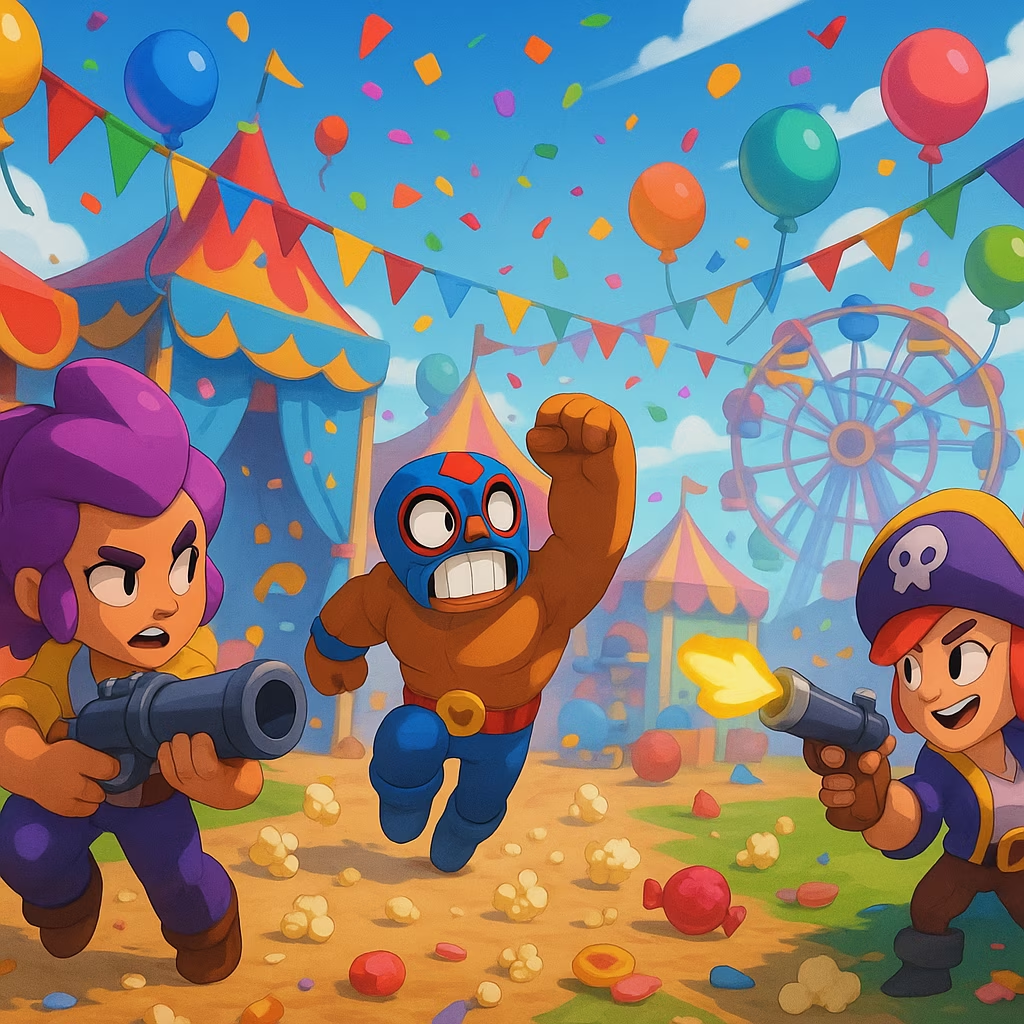
The saga of the underdog, the level one prodigy, once pulsed through the community like a secret rhythm. Players spoke in reverent tones of tacticians who could dismantle over-leveled opponents with nothing but placement, timing, and an almost poetic reading of the arena’s geometry. A well-timed zap, a sly archer split, an audacious skeleton barrel deployed at the river’s edge—these were the brushstrokes of a master. They turned the battlefield into a chessboard where the pieces wore no crowns, only convictions. As one veteran reminisced, the thrill lay not in the trophy count but in the sheer improbability of victory, a lovely sort of madness where every card drawn felt enchanted.
The Alchemy of Skill Over Strength
In those halcyon days, the matchmaker still breathed a certain wildness. It did not cage souls within rigid brackets; it allowed the improbable to bloom. A level one account could find itself face-to-face with towers towering three or four levels above, and yet the duel was not foregone—it was an invitation to greatness. The community’s storytellers, like the user Roenbaeck who recently revived this ache, plead for the return of such unscripted drama. They recall when progression was less a ladder and more a voyage of discovery, where a clever cannon placement could blunt a charging prince and a kite that drew a pekka across the entire lane felt like a victory parade. It was a time when the mettle of a player, not the metal of their card levels, forged legends.
These reminiscences are not merely nostalgia’s idle sighs; they reflect a profound belief that the spirit of competition should be measured in ideas, not experience points. Every lowbie conqueror became a folk hero, a living proof that the game’s core—the dance of elixir and instinct—could humble the grinder’s grind. The phrase “pushing your king level one account” once conjured images of a mythic quest, but as one commenter wryly noted, that quest is now “about five to eight years late,” a gentle epitaph for a chapter that is largely sealed.
The Walls That Rose from Good Intentions
Yet change, like the slow creep of crown towers, came with reasons wrapped in reason. Supercell, in its endless calibration, erected subtle barriers tied to king tower levels. The goal was noble: to quell the frustrations of unfair matchmaking that had soured many a climb. These adjustments, as user MCKlassik pointed out, were forges meant to harden the competitive steel, preventing the smurfery that left novices weeping in the training camp. But in tempering the blade, perhaps the smiths removed some of its magic. The new architecture funnels players into tighter lanes, where card levels and tower heights predetermine the horizon. No longer can a fresh account dream of dancing among the sirens of Serenity Peak or jousting with the legends in Legendary Arena. The spontaneous thrill, the electric fear of facing a giant skeleton when you have only a horde of goblins and a prayer, has been gentrified into predictability.
Many in the community now speak of a segregation—a polite term for a system that boxes warriors into categorical comfort. “It’s segregation, Clash Royale version,” one voice lamented, capturing the pang of forced belonging. Where once the arena echoed with the laughter of improbable matchups, a more orderly silence has settled. The irony is bitter: the same walls that protect the innocent also imprison the adventurous. The game that celebrated the unexpected has, for many, become a calculation, and the lowbie hero is now a specter haunting its edges.
Glimmers Amid the Regimented Fields
Yet hope, like a hidden Tesla, still crackles beneath the surface. The maestro of the low-level account has not vanished; they have merely adapted. They now tread paths more clandestine, exploiting the crevices where the matchmaker’s logic still permits a whisper of anarchy. StarsCheesyBrawlYT’s testimony that a level one account can still nibble four trophies per victory, and that some devoted souls have nudged those accounts toward the 8,000-trophy zenith, is a lantern in the gloom. These modern-day wanderers prove that the old fire is not extinguished; it flickers in the stubborn hearts of those who refuse to let the game dictate their narrative. They feel the same rush—the intoxicating blend of daring and discipline—and they remind the world that even within a framework of restrictions, artistry can survive. But it is not the effortless pilgrimage it used to be; it now demands a near-monastic patience, a willingness to endure lopsided losses in the name of the one glorious win that echoes the past.
The Emotional Pulse of a Community
Beneath the mechanics and the meta, Clash Royale is a loom of human connection. The threads woven in the lowbie era were dyed with camaraderie, with tales shared in clan chat and on forums that felt less like strategy meetings and more like campfire gatherings. When a level one topples a level twelve, it sparks more than a replay; it ignites a collective memory, a reminder of why they all fell in love with this frantic, card-flinging scramble. The emotional spectrum now stretches from wry acceptance—some players jest that they’ve found peace by simply leveling up their cards—to a profound sense of loss. One can hear the laughter that softens the sting and the sighs that carry the weight of cherished mechanics altered.
The conversations, sparked by a single query about “what happened to those thrill-packed low-level confrontations,” unveil a community still deeply in love with the game’s soul. They are poets at heart, mourning a lost dialect of play. Every reminiscence is a tribute, every suggestion a hope that the winds might change again. In these dialogues, the game transcends its code; it becomes a living chronicle of a people who found magic in a simple arena and refuse to let that magic be entirely written out.
The Unending Quest for Fairy-Tale Wars
As the sun sets on another season in 2026, the lowbie battle remains both a memory and a myth. The game has grown, sprouting evolutions, champions, and towers that sparkle with cosmetic histories. Yet, the core yearning persists—for the day when a fresh account could become a fable. Perhaps the developers, in their wisdom, will one day craft a mode, an event, a sliver of the old chaos, where tower levels fall away and the only currency is genius. Until then, the seekers will continue to push boundaries, and the storytellers will keep the legends alive. The beauty of skill over brute strength, of improbable victories pulled from the jaws of defeat, is not a relic to be archived; it is a flame that waits for the right wind to roar again.
For now, the lowbie battles sleep in the halls of memory, stirring only when a veteran faces a lower-level player and, in that suspended moment, chooses to match wits with an underleveled card or a unconventional tactic—silently saluting the ghost of what once was. The arena still holds the capacity for wonder. After all, the heart of Clash Royale has never been in the numbers, but in the stories written in elixir and courage. And the story of the lowbie dreamer, the one who conquered giants with nothing but conviction, is forever etched in the game’s eternal lore. Game on, indeed.